
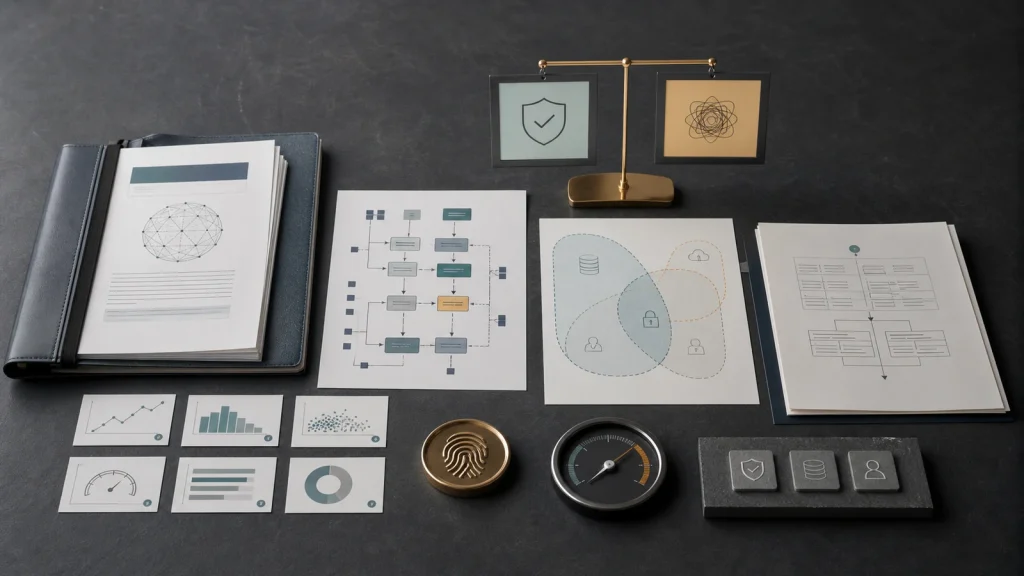
A good AI automation consultant should be able to explain the workflow, evidence, data boundaries, human controls, monitoring, ownership, and exit plan before asking you to trust a polished demo. The hiring decision is not mainly about which AI tools a consultant knows. It is about whether that consultant can build a system your business can operate safely and improve over time.
Ask for a workflow and operating baseline before discussing a preferred platform.
Require evidence from a realistic test, not a generic accuracy claim or curated demo.
Put data use, responsibilities, incident handling, ownership, and exit terms in writing.
A credible consultant should tell you when AI is unnecessary or an existing product is the better answer.
The Consultant Is Designing an Operating System
AI automation consulting reaches beyond connecting an API or configuring a chatbot. The consultant may influence how customer data moves, which decisions receive automated support, what staff review, how failures reach an operator, and whether the business can continue when a provider or model changes.
The Australian National AI Centre’s questions for AI suppliers organizes due diligence around risk, transparency, accountability, data, testing, human control, impacts, and exit. The same categories help a buyer evaluate a consultant who will select or assemble AI services.
1. Which Workflow Should We Change, and Why?
A strong consultant starts with a bounded workflow and a business outcome. Ask the consultant to name the trigger, required information, decision points, people involved, systems touched, exceptions, and output.
A weak answer jumps directly to agents, models, or a demo. A strong answer may also recommend that you simplify the process before adding AI. If the team is still choosing a starting point, use a disciplined method for deciding what to automate first.
2. What Baseline Will Prove the Change Helped?
Improvement needs a before-and-after comparison. Ask which current measures the project will capture, such as handling time, queue age, error rate, rework, missed handoffs, completion rate, customer response time, or operator capacity.
Be skeptical of a guaranteed percentage improvement without a measured baseline. The consultant should explain what will be measured, for how long, and which outside factors could affect the result.
3. What Evidence Supports Your Claims?
Ask for evidence that matches your actual task, data, and failure costs. A model benchmark, vendor case study, or consultant demo may not predict performance inside your workflow.
The Australian Government’s AI procurement checklist recommends defining evaluation criteria, seeking evidence against technical and nontechnical requirements, and including AI-specific safeguards in the final contract. A confident number without a relevant test should not carry much weight.
Ask for a pilot or evaluation set that includes normal cases, incomplete inputs, ambiguous requests, adversarial inputs, and known exceptions. Record both successful outcomes and the failures that require human intervention.
4. Where Will Our Data Go?
The consultant should produce a plain-language data-flow map. It should identify what enters the system, which vendors and subprocessors receive it, where it is stored, how long it remains, whether it trains models, who can access it, and how deletion works.
Ask how credentials, logs, prompts, retrieved documents, outputs, and backups are protected. “The vendor is secure” is not a data policy.
5. Where Do People Review, Override, or Stop the System?
Human review must connect to authority and consequence. Ask which outputs require approval, who can override them, how uncertainty appears to the operator, and what happens when no reviewer is available.
The answer should change with impact. Drafting an internal summary needs different controls from issuing a refund, rejecting an applicant, changing a price, or sending regulated advice. Review should be a designed path, not a promise that “a human stays in the loop.”
6. How Will the System Handle Failure?
A production design needs exception paths, safe states, and escalation. Ask what happens when an API times out, a source record is missing, a model returns invalid output, a confidence rule fails, or a downstream system rejects an update.
Look for retry limits, duplicate prevention, manual queues, alerts, reversible actions, and a way to pause the automation. The consultant should name the owner who receives each kind of failure.
7. How Will We Test and Monitor It After Launch?
AI behavior and the surrounding workflow can change after deployment. Ask how the consultant will monitor quality, latency, cost, failures, overrides, model or prompt changes, and the distribution of incoming work.
Require versioned changes and a way to compare results before an update reaches production. A consultant should specify the operating review cadence and the conditions that trigger retraining, redesign, rollback, or shutdown.
8. Who Owns What?
Responsibility should be explicit across setup, operation, support, incidents, and improvement. Ask who owns workflow decisions, code, configurations, accounts, prompts, evaluation data, documentation, and generated assets.
The AI procurement guidelines indexed by OECD.AI emphasize transparency, accountability, challenge-based evaluation, and continued information sharing because important system behavior may become clear only during deployment. Those expectations belong in the working relationship, not only the initial proposal.
9. What Will Our Team Be Able to Operate Without You?
A successful engagement should leave the business with usable capability. Ask what documentation, training, dashboards, runbooks, credentials, and handoff sessions the consultant will provide.
Your operators should know how to review work, recognize failure, pause the system, update approved knowledge, and request a controlled change. Permanent dependency should be a deliberate managed-service decision, not an accidental result of missing documentation.
10. How Do We Leave?
Exit planning reveals whether the consultant is building for your business or for lock-in. Ask how you can export data and configurations, transfer vendor accounts, revoke access, delete retained information, preserve essential history, and continue the workflow without the AI layer.
Put termination assistance, usable export formats, deletion commitments, and ownership terms in writing before the project begins.
Compare Evidence, Not Vocabulary
The best AI automation consultant is not the provider who uses the most advanced language. It is the provider who can explain the work clearly, show appropriate evidence, design boundaries and human control, assign responsibilities, and leave you with a system that can be monitored, changed, and exited.
A useful proposal should make the business easier to operate before it promises more autonomy. Eckman Design helps teams map workflows and build practical automation systems with the controls needed for real operations.