
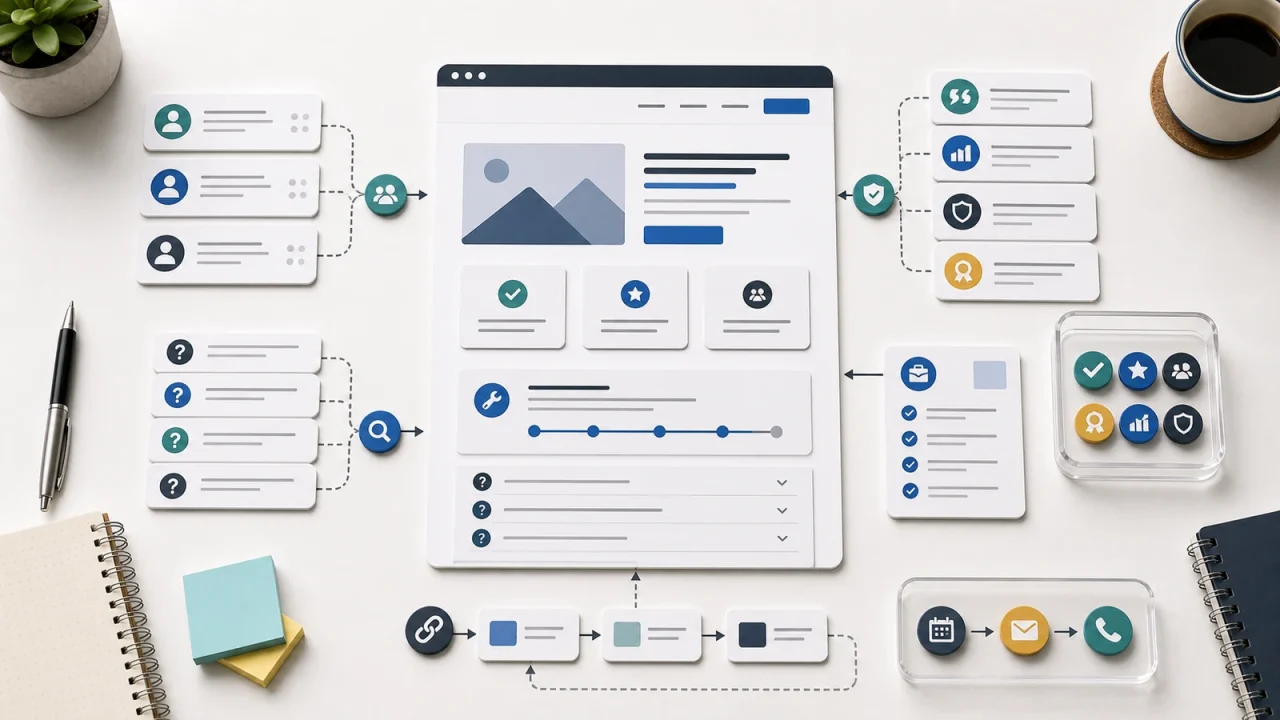
Service page SEO fails when the page tries to sell before it answers the buyer’s real questions clearly and credibly enough.
A service page should explain the problem, the buyer fit, the service scope, the process, the proof, the risks, and the next step.
Search visibility improves when the page gives clear answers instead of vague claims.
AI search and LLM discovery also depend on specific, extractable sections that explain what the service does and who it helps.
The goal is not to stuff keywords into a sales page. The goal is to make the buying decision easier.
A Service Page Is A Buying Tool
A service page is often treated like a brochure. The page lists what the company does, adds a few benefits, includes a button, and assumes the buyer will understand the rest. That approach leaves too much work for the reader and weakens qualified demand.
A qualified buyer is usually not looking for slogans. The buyer is trying to decide whether the company understands the problem, whether the service matches the situation, whether the process feels credible, and whether the next step is worth taking.
That is why service page SEO should start with buyer questions. The page has to earn search visibility and buyer trust at the same time. If the page ranks but does not answer the decision-making questions, the traffic will not matter much.
For a business website, the strongest service pages connect search intent to operational clarity. They explain what the service solves, where it fits, what the process requires, and how the visitor should think about the decision.
The Page Should Define The Service Clearly
Search systems and buyers both need the same basic signal: what is being offered. A service page should name the service in plain language and connect it to the real business problem it solves.
The Schema.org Service type is a useful reminder that a service has definable properties: provider, area served, audience, offer, terms, and related details. The page does not need to expose every technical property in copy, but it should explain the service well enough that a human and a machine can classify it.
A weak service page says the company provides custom solutions. A stronger service page explains the specific system, workflow, website, automation, integration, or operational problem the service addresses. Specific language helps readers understand fit and helps search systems understand relevance.
That clarity also matters for AI search and LLM discovery. If a section is extracted into an answer, it should still explain the service without relying on the reader to remember the whole page.
Answer The Questions Buyers Actually Ask
A strong service page should answer the questions a serious buyer is already asking. The buyer may not ask those questions in perfect marketing language, but the concerns are usually practical.
- What problem does this service solve?
- What type of business is a good fit?
- What is included and what is not included?
- What does the process look like?
- What information does the buyer need to provide?
- What risks or tradeoffs should the buyer understand?
- What proof shows the provider can do the work?
- What happens after the first conversation?
These questions are not filler. They are the structure of the buying decision. A page that answers them feels more useful because it reduces uncertainty.
This is similar to on-page SEO for business. The best page is not the one with the most keyword mentions. It is the page that explains the topic clearly enough for people, search engines, and answer systems to understand it.
Show The Process Before The Pitch
Buyers trust a service page more when they can see how the work will happen. Process gives shape to an otherwise abstract promise.
A process section does not need to be long. It should explain the major stages: discovery, assessment, planning, implementation, review, launch, support, or whatever sequence fits the service. Each stage should tell the buyer what decisions happen and what output they can expect.
For example, a website operations service might start with a site audit, then identify publishing bottlenecks, technical risks, content gaps, analytics needs, and maintenance responsibilities. That process is more useful than a claim that the team builds better websites.
Process also helps qualify the lead. A buyer who wants a one-day shortcut may not be a fit for a service that depends on planning, governance, and maintainability. Clear process prevents misaligned conversations before they start.
Use Proof That Supports The Decision
Proof should answer buyer risk, not decorate the page. Testimonials, examples, before-and-after details, process artifacts, screenshots, metrics, and case notes should all connect to a specific question the buyer has.
A vague testimonial that says the team was great may help, but it does not explain capability. A stronger proof point shows the problem, constraint, action, and result. For example, it might show how a publishing workflow became easier to maintain or how a lead intake process stopped losing requests.
Proof does not always need to be a full case study. A service page can include concrete examples of outputs: audit findings, workflow maps, content models, dashboards, integration plans, or launch checklists. These artifacts help buyers understand what they are buying.
Connect The Page To The Rest Of The Website
Service pages should not stand alone. Internal links help buyers learn more and help search systems understand topic relationships.
A service page about website strategy may link to content about website migration operations, technical SEO, on-page SEO, analytics, privacy, or maintainability. A service page about automation may link to workflow audits, CRM cleanup, API integrations, and intake workflows.
The links should be useful, not decorative. If the next page helps the buyer understand a decision, add the link. If the link only exists to force a keyword into the page, leave it out.
Make The Next Step Specific
A service page should make the next step clear without pressuring the visitor. The best call to action matches the buyer’s stage of readiness.
Some buyers are ready to talk. Others need to compare options, read related guidance, review examples, or understand whether the service fits their situation. A useful page can offer a primary next step and a quieter secondary path.
The next step should also tell the buyer what to expect. “Schedule a consultation” is clearer when the page explains what will happen in that conversation, what information is helpful, and what the business will get out of the discussion.
The Better Service Page
The better service page does not try to close the deal before it has earned trust. It answers buyer questions, explains the service, shows the process, provides relevant proof, and gives the visitor a clear next step.
That is also better SEO. Search visibility improves when the page has useful structure, specific language, internal context, and content that answers the query behind the keyword. The page becomes easier for a person to evaluate and easier for search systems to understand.
If a service page feels thin, start by listing the questions a qualified buyer asks before a sales conversation. Then answer those questions directly. The result will usually be a stronger page than any keyword checklist can produce.
Discussion
0 Comments