
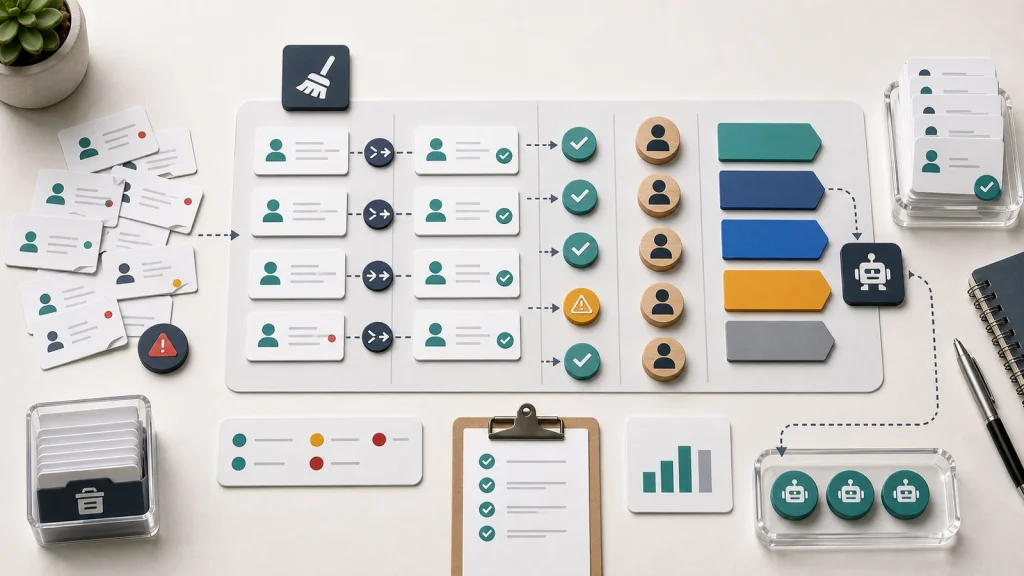
CRM cleanup should happen before sales automation because automation quickly multiplies whatever visible data problem already exists.
Sales automation depends on trusted records, clear lifecycle stages, ownership, and consistent pipeline rules.
A messy CRM turns follow-up sequences, lead scoring, routing, reminders, and reports into faster confusion.
CRM cleanup is not just a data project. It is a sales operations project with process, ownership, and governance decisions.
Start with the workflows that rely on CRM data, then clean the fields, records, stages, and responsibilities those workflows need.
Automation Amplifies The Current CRM
Sales automation looks attractive when the team is behind on follow-up, routing, qualification, and reporting. The promise is reasonable: fewer manual reminders, better handoffs, more consistent next steps, and a clearer pipeline.
However, automation does not fix the CRM underneath it. Automation reads the existing records, fields, owners, stages, dates, and rules. If those inputs are unreliable, the automation will move unreliable information faster.
A duplicate contact can receive two nurture paths. A stale lifecycle stage can trigger the wrong follow-up. A missing owner can route a qualified lead into silence. A vague pipeline stage can make the forecast look cleaner than the sales process really is.
That is why CRM cleanup belongs before sales automation. The cleanup gives automation a stable operating surface. Without that surface, the team spends more time explaining exceptions than improving sales work.
Define The Sales Process Before Cleaning Fields
A CRM cleanup project should start with the sales process, not with a spreadsheet of fields. Field cleanup only works when the team knows which decisions those fields support.
For example, a lead source field matters if the company uses it to compare channels, route inbound requests, or measure campaign quality. A budget field matters if it changes qualification or proposal timing. A lifecycle stage matters if everyone agrees what movement between stages means.
Before changing the CRM, map the sales workflow. Identify the first touch, qualification criteria, handoff rules, proposal path, close criteria, lost reason categories, and post-sale transfer. Then decide which CRM data is required for each decision.
This workflow-first approach is similar to data quality before AI automation. The issue is not only whether the field exists. The issue is whether the business trusts the field enough to let a system act on it.
Clean The Records That Automation Will Touch
CRM cleanup does not require perfect data everywhere before the team improves anything. It requires reliable data in the records and fields that automation will use first.
Start with duplicate contacts, duplicate companies, missing owners, invalid emails, stale open deals, inconsistent lifecycle stages, old task queues, and required fields that salespeople routinely skip. These problems create visible automation failures.
HubSpot’s data quality command center documentation is a useful example of the kinds of operational checks teams need to watch: duplicates, formatting issues, property problems, and data health over time. The specific CRM matters less than the discipline. Data quality has to become observable.
- Merge or resolve duplicate people and companies before triggering sequences.
- Confirm record ownership before routing new opportunities.
- Standardize lifecycle stages before using automated nurture rules.
- Archive stale deals before using pipeline reports for capacity planning.
- Clean required fields before building lead scoring or segmentation.
Assign Ownership For Data Quality
CRM cleanup fails when everyone agrees the data is bad but nobody owns the correction process. Ownership turns cleanup from a one-time rescue into a recurring operating habit.
The team should know who can create fields, who can change stage definitions, who reviews duplicates, who audits stale records, and who decides when a value should be retired. Without these decisions, the CRM drifts back to its old state after the cleanup sprint ends.
Ownership also helps salespeople trust the system. If reps believe CRM data is ignored, they will treat CRM updates as administrative overhead. If the CRM drives routing, priorities, reporting, and customer handoffs, the records become part of how work gets done.
The same pattern appears in customer intake workflows. Capture is not enough. The business needs routing, response expectations, ownership, and review paths after the information enters the system.
Build Automation Around Clear Rules
Sales automation works best when the rules are simple enough to explain. If the team cannot explain when a lead should route, when a deal should advance, or when a task should escalate, automation will encode confusion.
A reliable first automation might route inbound leads by service line, assign ownership based on territory, create a follow-up task after a qualified call, or alert a manager when a deal is stuck. These automations depend on clean inputs and clear responsibilities.
A weaker automation tries to compensate for unclear process. It sends more reminders, creates more tasks, and flags more exceptions, but the team still does not know which information is trustworthy. That creates alert fatigue instead of sales momentum.
This is why low-code automation needs workflow ownership. The CRM tool may make rules easy to build, but the business still has to define the rules it wants to operate.
Use A Practical Cleanup Sprint
A practical CRM cleanup sprint should focus on the next automation goal. The team does not need to fix every historical issue before making progress. It needs to reduce the specific risks that would make the first automation unreliable.
- Choose one workflow, such as inbound lead routing or proposal follow-up.
- List the fields, owners, stages, and records that workflow requires.
- Audit the current data for duplicates, blanks, stale values, and inconsistent definitions.
- Assign cleanup owners and decide which records can be archived.
- Test the automation on a small segment before connecting it to the full pipeline.
- Review failures weekly and adjust the cleanup rules before expanding.
This sprint turns CRM cleanup into operational design. The output is not a prettier database. The output is a sales workflow the team can trust.
Measure Cleanup As Sales Reliability
CRM cleanup should have practical measures, not vanity measures. A lower duplicate count is useful, but the business also needs to know whether sales work became more reliable.
Track the percentage of new records with a valid owner, the number of leads routed without manual repair, the age of open tasks, the number of stale deals, and the share of records that can move through the next automation without missing required information. These metrics connect cleanup to operating performance.
The review should include salespeople, managers, and anyone who depends on CRM reporting. If the data looks cleaner but the team still works from side spreadsheets, private notes, or inbox reminders, the cleanup did not reach the workflow. The real test is whether the CRM becomes the place where sales work can be trusted.
The Better Starting Point
Before adding sales automation, pick one workflow that currently depends on CRM data and follow it from intake to decision. Watch where records duplicate, where owners disappear, where stages mean different things, and where the team falls back to side-channel updates.
Those issues are the real automation requirements. Fix them first. Then automate the parts that repeat. Sales automation works when the CRM reflects the sales process closely enough that the system can help the team move work forward instead of creating a faster mess.