
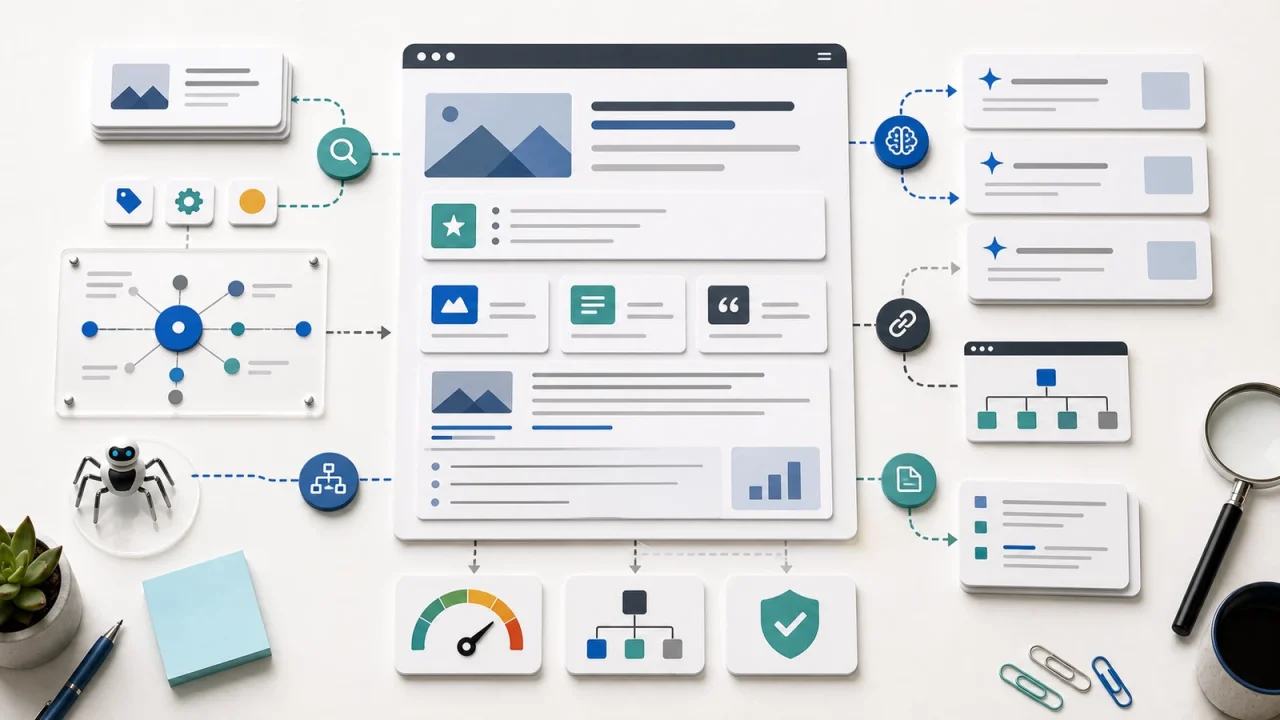
On-page SEO for business now has to make a page clear to people, search engines, and AI answer systems at the same time.
On-page SEO still depends on titles, headings, clean URLs, internal links, metadata, image context, and page speed.
AI search and LLM discovery add a second requirement: the page must be easy to extract, summarize, and cite in isolated chunks.
Business pages need clear entities, answer-first sections, structured data, crawl permissions, and proof that supports the claim.
The practical goal is not to chase every search feature. The goal is to make the page easier to understand, trust, and maintain.
This guide was originally published in 2016. The basics still matter, but the job has changed. A business page can no longer treat on-page SEO as a quick checklist of keywords, titles, descriptions, and alt text.
A search-ready page now needs to explain its purpose quickly, answer the reader’s question directly, support machine understanding, and remain useful after the first click. That is why on-page SEO for business belongs with content strategy, website operations, performance, privacy, accessibility, and measurement.
Start With A Clear Page Purpose
Every important page needs one primary job before the team edits keywords, headings, or metadata. A service page may need to qualify a lead. A guide may need to answer a practical question. A contact page may need to make the next step obvious.
Define the audience, question, proof, and next action. If the page purpose is vague, the SEO will usually become vague too. Search systems and AI answer systems both work better when the page has a clear topic, a clear audience, and a clear outcome.
- Audience: who should this page help?
- Question: what problem or decision does the page answer?
- Proof: what evidence, examples, process, or experience supports the answer?
- Action: what should the reader understand or do next?
Use Clean URLs, Titles, And Descriptions
Clean URLs, title tags, and meta descriptions still help people and search engines understand the page before they open it. These elements should describe the page in plain language instead of repeating keywords awkwardly.
A URL like /blog/?p=123 gives no context. A URL like /blog/on-page-seo-for-business/ explains the topic. In WordPress, this usually means using readable post-name permalinks and keeping important URLs stable over time.
The title tag should match search intent and set a real expectation. Google’s SEO starter guide explains that title links can come from several page signals, including the title element and visible headings. The visible title, SEO title, and body content should reinforce the same topic.
The meta description should summarize the page in one or two useful sentences. It does not guarantee rankings, but it can help a searcher decide whether the page is worth opening. For a business page, avoid generic claims and describe the problem, service, or outcome directly.
Write For Extraction, Not Just Scanning
LLM discovery changes how business content should be structured. A reader scans the whole page, but AI systems often retrieve and summarize isolated chunks. Each section should make sense when it appears away from the rest of the article.
That means each H2 should open with a direct answer before adding nuance. Avoid starting sections with vague pronouns such as “this” or “it.” Name the subject. “Structured data helps machines classify visible page content” is clearer than “It helps them understand it.”
Answer-first writing does not mean flat writing. It means the page gives the reader a useful statement quickly, then explains the details, examples, tradeoffs, and next steps. This format helps human readers, search engines, and AI answer systems understand the same argument.
| Page Element | Traditional SEO Role | AI Discovery Role |
|---|---|---|
| H1 and title | Names the page topic | Anchors the entity and main answer |
| H2 sections | Organize scan paths | Create extractable answer chunks |
| Internal links | Connect related pages | Show topic relationships and authority paths |
| Structured data | Classifies page content | Gives machines cleaner facts about visible content |
| Examples | Improve usefulness | Add information gain that summaries can cite |
Make The Heading Structure Easy To Follow
Heading structure should explain how the page thinks. Use one H1 for the main page topic. Use H2s for major sections and H3s for supporting points inside those sections.
Do not use headings only because they make text look larger. Use headings for structure and CSS for visual styling. The test is simple: if someone reads only the headings, they should still understand the page’s logic.
For LLM search, headings also help identify useful chunks. A section called “Use Better Metadata” is less useful than “Use Meta Descriptions To Set Searcher Expectations.” The second heading gives the retrieval system and the reader a clearer job for the section.
Answer The Real Business Question
The strongest on-page SEO signal is still useful content. A business page should not merely repeat a target phrase. It should answer the question better than a generic competitor page.
Useful content names the situation, explains the tradeoffs, gives practical examples, and tells the reader what to inspect next. For a service page, that may mean explaining who the service is for, what the process includes, what decisions matter, and what a buyer should prepare before a conversation.
For a blog post, that may mean answering a question the buyer is already asking while they feel operational pain. A post about customer intake workflows should explain what happens after the form. A post about website migration checklists should explain what must keep working after launch.
Add Entity Clarity For AI Search
AI search systems need to understand what the page is about, which business or author is responsible for it, and how the page relates to other trusted information. Entity clarity helps reduce ambiguity.
For a business website, entity clarity comes from consistent names, clear service descriptions, author or company context, accurate organization information, useful internal links, and content that matches what the business actually does. A page should not make a search system guess whether the company is a design studio, software team, automation consultant, or publishing platform.
For Eckman Design, on-page SEO connects to privacy-first websites, performance, structured content, practical automation, and maintainable digital operations. The website is not just a brochure. It is part of the operating model for visibility, lead capture, publishing, and trust.
Use Internal Links To Build Topic Clusters
Internal links help visitors move through the site and help search systems understand which pages relate to each other. Topic clusters work best when the links are useful to the reader, not added mechanically.
A page about on-page SEO can naturally link to website operations, content maintenance, analytics, technical SEO, structured content, and LLM visibility. A page about automation can link to workflow audits, data quality, permissions, and human review. The internal links should show a real relationship between business problems.
Internal links also support AI retrieval because they help define how the site’s ideas connect. A strong cluster makes it easier for a system to understand that SEO, privacy, performance, analytics, and maintainability are part of the same website strategy.
Use Outbound Links Where They Add Evidence
Outbound links are useful when they help the reader verify a claim, understand a standard, or take a practical next step. Official documentation is usually stronger than a recycled SEO checklist.
For AI search specifically, Google’s guidance on AI features and your website is a useful source because it explains how normal search crawling, indexing, snippets, structured data, and preview controls affect eligibility and display. OpenAI also documents its crawlers and user agents, which matters when a business is deciding how crawl permissions should work.
The practical rule is simple: do not block important public content from legitimate crawlers unless there is a clear business reason. At the same time, do not expose private, low-quality, duplicate, or operational content simply because a crawler might find it.
Give Images Useful Context
Image SEO is not about stuffing keywords into filenames and alt fields. Images should support the surrounding content, and alt text should describe the image for people who cannot see it.
If an image explains a process, the alt text should describe the process. If an image is decorative, it may need empty alt text instead of forced keywords. The surrounding caption, heading, and paragraph can also help search systems understand why the image belongs on the page.
Add Structured Data Where It Fits
Structured data gives machines a cleaner way to classify visible page content. It does not guarantee rankings or rich results, but it can reduce ambiguity when the markup is accurate.
Google describes structured data as a standardized format for providing information about a page and classifying its content. The important rule is to mark up only what is visible and true on the page.
For many business sites, useful structured data may include Organization, LocalBusiness, Article, BreadcrumbList, FAQPage when real FAQs are visible, Product when there is a real product, or Service-style content implemented through the site’s SEO tooling. The exact schema matters less than accuracy and maintainability.
Treat Performance, Accessibility, And Privacy As SEO Signals
On-page SEO is not isolated from the rest of the website experience. A slow, inaccessible, or privacy-hostile page is harder to trust even when the copy is clear.
Start with tools like PageSpeed Insights, but do not chase the score blindly. Look at real issues: image weight, render-blocking CSS, unused JavaScript, slow server response, layout shift, third-party scripts, mobile usability, and templates that make publishing harder than it should be.
Performance, privacy, and accessibility are also operational concerns. A site that is difficult to maintain will slowly lose search value because content gets stale, templates get inconsistent, analytics break, and teams stop trusting the publishing process.
Use A Practical On-Page SEO And AI Discovery Checklist
A modern review should check whether the page is useful, extractable, technically sound, and operationally maintainable. The checklist should help a team improve the page, not merely score it.
- Define the page purpose, audience, question, proof, and next action.
- Use a stable, descriptive URL that does not need frequent changes.
- Write a specific title tag and H1 that match the same topic.
- Use a meta description that sets an honest expectation.
- Open each major section with a direct, self-contained answer.
- Name the business, service, process, or entity clearly instead of relying on vague pronouns.
- Add internal links where they help the reader understand related topics.
- Use outbound links only when they add evidence or useful context.
- Describe meaningful images with useful alt text.
- Add structured data only when the marked-up content is visible and true.
- Check crawl permissions, robots controls, and preview settings for public pages.
- Measure mobile performance, accessibility basics, privacy behavior, and conversion paths.
The 2026 View: On-Page SEO Is Operational Clarity
The old version of on-page SEO treated the page as a set of fields to optimize. The stronger 2026 view treats the page as a business asset that has to communicate clearly, perform well, and stay maintainable.
Can the page explain what it is about? Can a visitor find the answer? Can search engines crawl and understand it? Can AI answer systems summarize it correctly? Can the business maintain and improve it over time?
That is the real work. On-page SEO for business is not just about ranking higher. It is about making the website easier to understand, easier to trust, and easier to operate.
Eckman Design builds privacy-first, performance-focused websites with structured content, practical SEO, and maintainability in mind. If your pages are hard to explain, hard to crawl, or hard to update, start with the operating model behind the content before chasing another checklist.
Discussion
0 Comments