
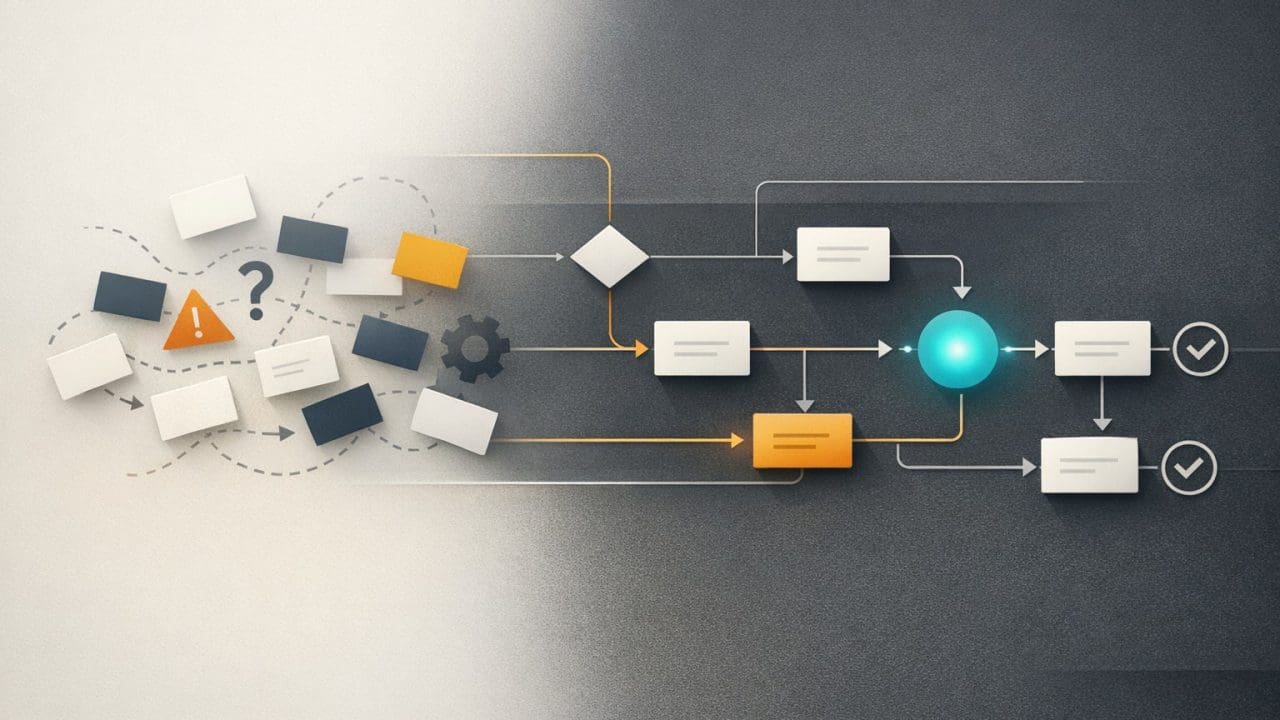
Most AI automation projects start in the wrong place.
The conversation often begins with the tool. Should the business use AI agents? Should it connect ChatGPT to the website? Should it automate emails, intake forms, customer service, reporting, or internal tasks?
Those may become useful questions. However, they are not the first questions.
The better place to start is with the business problem. What is slowing the team down? Where is work getting stuck? What takes too many follow-ups? Where are mistakes happening? Which process depends too much on someone remembering the next step?
AI automation should not be added just because the technology is available. It should be used where it solves a real operational problem.
Start With the Problem, Then Map the Workflow.
AI is most useful when it connects to a specific business outcome.
That outcome might be faster intake, cleaner approvals, fewer manual handoffs, better customer responses, more consistent publishing, or less time spent copying information between systems.
Once the problem is clear, the next step is to understand how the work actually moves. A practical automation project should map where the work starts, what information it needs, who reviews it, what decisions matter, what happens when something is missing, what needs approval, and what the final output should look like.
That is where AI starts to become useful. Not as a novelty, but as part of a better system.
MIT Sloan has made a similar point about AI leadership: organizations need to define the business problem before they chase the technology. That principle matters even more for small teams, where every new tool has to earn its place in the workflow.
AI Automation Should Support the Work.
A business does not need AI for the sake of AI. It needs better ways to move work forward.
Sometimes that means AI. Sometimes it means a better form, a cleaner database, a dashboard, an approval workflow, or a simpler publishing process. Often, it means a combination of these pieces.
The point is to design the system around the business problem first. Then AI can be added where it creates real value.
This distinction keeps the project grounded. It also helps the team avoid building a clever demo that never becomes part of daily work.
The Workflow Reveals Where AI Belongs.
When the workflow is mapped clearly, the right automation opportunities become easier to see.
AI may help by reading incoming requests, summarizing information, classifying tasks, drafting responses, checking for missing details, creating first-pass content, or preparing work for review.
However, not every step needs AI. Some parts of the process may only need clearer instructions, better routing, cleaner data, or a more reliable handoff.
That distinction matters. A thoughtful automation project does not ask, “Where can we add AI?” It asks, “Where is the work breaking down, and what would make this process easier to run?”
Automation Needs Boundaries.
The best AI systems are not vague. They are designed with clear limits.
A useful automation system should know what it is trying to accomplish, what information it can use, what it can draft or recommend, what requires human review, what should never be automated, what happens when information is missing, and where final approval happens.
This is especially important for business processes that affect customers, sales, operations, compliance, payments, or public-facing content.
The goal is not to remove people from every decision. The goal is to reduce repetitive work, improve consistency, and give people better information when they need to make a decision.
Better Systems Reduce Coordination.
Many businesses lose time in the handoffs.
Someone fills out a form. Someone forwards an email. Someone asks for clarification. Someone copies details into a spreadsheet. Someone waits for approval. Someone follows up because no one is sure where the task stands.
AI can help, but only if the underlying process is designed well. A better system can capture the request, organize the information, flag missing details, route the task, prepare the next step, and keep a record of what happened.
That is more valuable than simply adding an AI chatbot to the side of an existing workflow. It turns the workflow itself into something the business can see, operate, and improve.
This is the same practical lens behind Eckman Design’s work on AI automation and digital systems: start with the work, then build the system that helps the work move.
Start With Practical Questions.
Before investing in AI automation, ask what problem the team is trying to solve. Then ask how that work happens today, where the process slows down, what information is usually missing, and who needs to review or approve the work.
From there, look at the decisions. Which decisions repeat often? Which decisions require judgment? What would a cleaner version of this process look like? Where could AI reduce repetitive work or improve consistency?
These questions usually reveal the right starting point. They also help the team avoid building something impressive that no one actually uses.
AI Is Only Useful if It Fits the System.
The strongest automation projects do not start with a tool. They start with a problem worth solving.
AI can be powerful, but it works best inside a clear operating system: defined inputs, structured workflows, useful context, human review, and measurable outcomes.
That is how AI moves from experiment to infrastructure.
A business that starts with the problem will usually build something more useful, more reliable, and easier to maintain. A business that starts with AI for its own sake may end up with a clever demo that never becomes part of daily work.
Eckman Design helps businesses turn messy workflows into practical AI-assisted systems. If your team is exploring automation, start by understanding the problem and mapping the work.
Discussion
0 Comments