
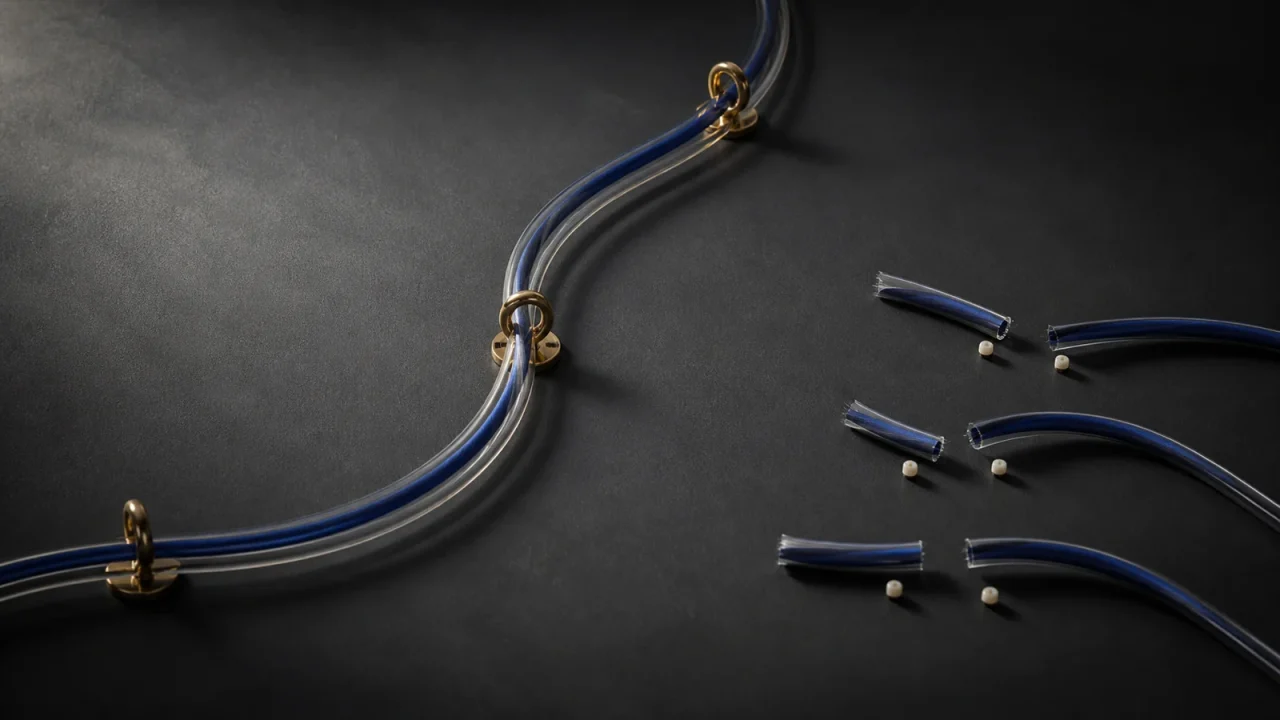
Continuous audio time stretching can correct bounded lip-sync differences more safely than cutting and splicing individual words because it preserves transitions, room context, and the shape of the surrounding phrase. It is not the right answer for every mismatch, but it gives the renderer a coherent timing map instead of a pile of local edits.
Word boundaries are useful alignment evidence but unreliable edit points.
A continuous timing map must always move forward and stay within an approved correction range.
AI can propose anchors; a deterministic renderer should apply the correction.
Low-confidence evidence should produce pass-through or review, not forced alignment.
A subtitle, transcript, or alignment model can make speech look like a sequence of clean boxes. Audio is not that tidy. Consonants begin before a word boundary, vowels carry energy into the next word, breaths cross phrase edges, and room tone connects everything. Editing each box independently can damage the continuity the listener actually hears.
Continuous audio time stretching changes duration while preserving context
Time-scale modification changes the duration of audio without intentionally changing its pitch. A published review of time-scale modification describes multiple algorithm families, their artifacts, and the fact that no single method is ideal for every signal.
In a lip-sync workflow, continuous correction does not mean stretching an entire soundtrack by one percentage. It means defining a smooth, forward-moving relationship between selected points in the original and corrected dialogue, then letting a renderer adjust the material between them.
The method preserves more local context than independent word edits, but it still needs strict limits. A mathematically valid map can produce an unnatural performance if it compresses speech too aggressively or moves a pause that carries meaning.
Word boundaries are not clean audio edit points
Automatic speech recognition and forced alignment can estimate where words occur. Those timestamps are valuable for navigation and evidence, but they do not guarantee a silent or perceptually safe cut at each boundary.
A cut can land inside a breath, reverb tail, fricative, plosive release, or overlapping sound. Splicing the isolated word back into place may create a click, truncate a transition, duplicate ambience, or change the space between words. Crossfades can hide some discontinuities while smearing others.
The more edits a line receives, the more these small problems accumulate. The output may hit every target timestamp and still sound assembled rather than performed.
The comparison emerged from restoration and alignment designs
Across private audio-restoration and audio-video alignment designs, we compared how local timing decisions affect the integrity of the complete phrase. The recurring risk was that a correction optimized for a word boundary while weakening the transitions around it.
This field note explains the design pattern without disclosing private algorithms, formulas, windows, rate limits, models, weights, source media, client samples, or measured results. The reusable idea is to separate evidence selection from a bounded deterministic render.
That separation helps the system improve without becoming opaque. Alignment evidence can evolve. Rendering remains governed by explicit invariants, and the final artifact still has to prove the correction worked.
Compare correction methods by the invariants they preserve
| Method | Potential strength | Primary risk | Best operational use |
|---|---|---|---|
| Independent word splicing | Targets a narrow local event | Clicks, truncated transitions, duplicated room tone, broken phrasing | Exceptional repair with verified edit boundaries |
| Continuous timing map | Preserves phrase context and distributes correction | Unnatural rate or moved emphasis if anchors are weak | Bounded correction with trustworthy anchors |
| Phrase or silence movement | Preserves speech performance | Changes pause placement or neighboring timing | When available silence can absorb the difference |
| Regeneration or rewrite | Can improve the underlying performance or fit | May change voice, meaning, cadence, or artifacts | When the candidate itself cannot support safe correction |
| Pass-through and review | Avoids speculative damage | Leaves a possible mismatch unresolved | When evidence is ambiguous or correction cost is high |
The decision is not continuous versus spliced in every case. It is which method protects the most important invariants for this line, using the evidence actually available.
A continuous timing map must always move forward
A safe map is monotonic: as original audio time moves forward, corrected time also moves forward. It cannot reverse a fragment, fold two regions onto each other, or create an impossible cue order.
Selected anchor points define relationships the workflow wants to preserve. The start and end of an utterance may be anchors. A strong pause, visible reaction, or confidently aligned emphasis point may add internal anchors. The renderer changes timing between those points rather than treating every word as an isolated object.
Too many anchors can over-constrain the phrase and turn noisy evidence into audible edits. Too few can move an important beat. Anchor selection should therefore express confidence and editorial importance, not simply use every timestamp a model produced.
Bounded rates protect natural performance
Every correction policy needs limits. Those limits may vary with language, voice, material, renderer, and review expectations. The public article should not pretend one percentage works everywhere.
The workflow can still enforce a general rule: if the required correction exceeds the approved operating range, do not ask the renderer to conceal a translation or performance problem. Route the line to rewriting, regeneration, or review.
Rate limits can also apply locally. A phrase that averages a modest adjustment may contain one short region with an extreme change. Inspect the map between anchors, not only the start-to-end average.
Silence is part of the performance, not free storage
Moving or resizing silence can absorb timing differences without transforming voiced speech. That can be the least destructive option when the pause is incidental. It can be the wrong option when hesitation, interruption, comedic timing, or turn-taking depends on the pause.
Dubbing translation timing should preserve pause shape, cadence, intent, and visible action alongside total duration. Those constraints should inform whether silence is available to move.
The system should not classify every low-energy interval as disposable. Speech context, neighboring speakers, room tone, music, and picture events can all change its role.
AI should propose anchors, not own the renderer
Speech, language, and visual models can propose word positions, pause regions, speaker turns, mouth activity, and likely emphasis. Those signals are useful for suggesting where the timing map should hold or move.
A deterministic policy should decide which signals qualify as anchors, whether the map remains monotonic, whether local changes stay bounded, and which artifact version the correction applies to. The renderer should receive an explicit map and produce a new version with recorded lineage.
When signals disagree, preserve the disagreement. A model’s confidence should not be converted into invisible certainty. Low-confidence anchors can be omitted, sent for review, or used only as annotations.
Real renderers have corner cases that the design must respect
Implementation details vary, but time stretching is not a generic slider. The Rubber Band project’s technical notes describe transient handling, adaptive ratios, offline sample-accurate behavior, and practical corner cases in one widely used implementation.
That is not an endorsement of one library or a claim that its behavior applies everywhere. It is public evidence for an important architecture decision: the workflow should treat the renderer as a versioned technical component with declared capabilities and validation, not a perfect mathematical function.
Changes in renderer version, operating mode, input channel structure, or sample rate can affect the artifact. Those facts belong in the job record and can invalidate earlier acceptance evidence.
Measure the artifact after correction
The requested timing map and the computed output are not proof of the rendered result. The renderer may add padding, shift a boundary, alter duration unexpectedly, or produce an audible artifact while returning success.
Compare the corrected file with its intended anchors on the same timeline used for picture, dialogue, and cues. Measure total duration, local residuals, start and end position, silence and transition behavior, and any technical defects the operation could introduce.
A shared audio-video timeline prevents locally correct timing changes from becoming full-program drift. Smaller dubbing QC gates can then route alignment, artifact, performance, and mix failures independently.
No correction is a valid system output
A mature workflow can decide that it lacks trustworthy anchors, the requested change exceeds policy, the line is already acceptable, or the safest repair is editorial. Passing the original artifact through with a review flag is better than forcing every input through a transformation.
This stopping rule is especially important with AI-derived evidence. Model availability makes a correction possible; it does not make the correction justified.
Continuous audio time stretching is valuable when it preserves phrase context, follows trustworthy anchors, stays monotonic and bounded, and proves its output after rendering. Used that way, it becomes one repair option inside a controlled media workflow rather than an automatic answer to every sync difference.
If timing repair is producing technically aligned but audibly damaged dialogue, Eckman Design can help define the evidence, correction policies, and validation boundaries around the workflow.
Discussion
0 Comments