
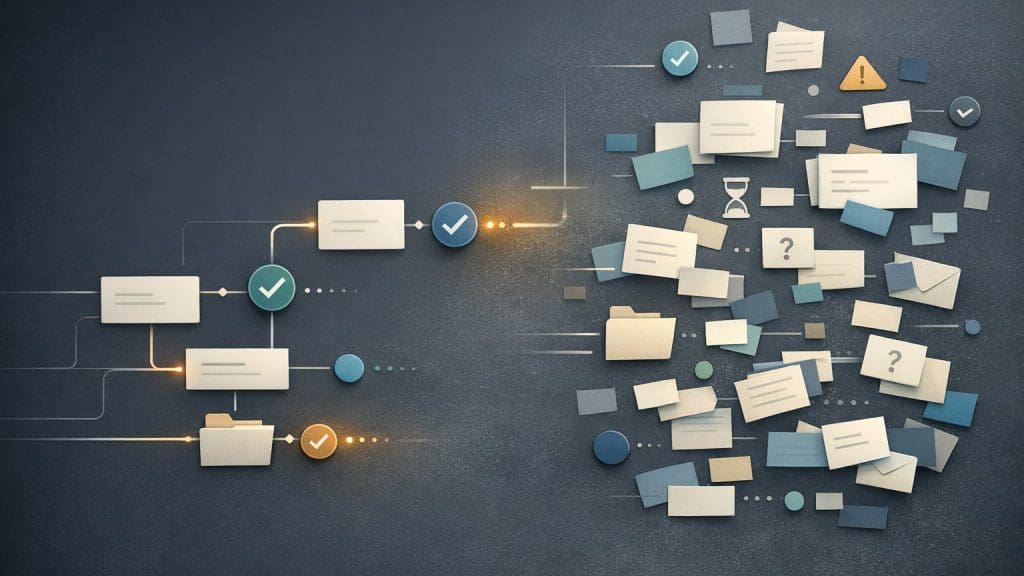
Manual handoffs rarely look expensive at first.
Someone sends a message. Someone copies data from one system to another. Someone asks for approval. Someone follows up. Someone checks a spreadsheet. Someone updates the status.
Each step seems small. However, manual handoffs become an operating cost when they carry important context between tools, people, and decisions.
The cost does not always show up as a line item. It shows up as slow approvals, repeated explanations, missed details, unclear ownership, and teams that feel busy without seeing where the work actually goes.
Manual Handoffs Are Where Work Gets Lost.
Most businesses do not struggle because people ignore the work. They struggle because work moves through unclear systems.
A request starts in email. The details get clarified in chat. The file lives in a shared folder. The approval happens in a meeting. Then the final status gets tracked in a spreadsheet that only one person really understands.
No single step looks complicated. In practice, though, the full process becomes fragile because the context lives everywhere except the work itself.
That fragility creates delays, duplicate work, and missed context. It also makes the business harder to manage because leaders cannot see where the process slows down.
Coordination Does Not Scale.
As a business grows, coordination gets harder.
More people touch the same process. More tools enter the workflow. More exceptions appear. More approvals become necessary. Meanwhile, customers expect faster responses and clearer communication.
If the workflow depends on people remembering every step, the process will eventually break. Not because the team lacks discipline, but because the system asks people to carry too much invisible work.
Asana describes this kind of coordination burden as work about work: the status updates, searching, switching, and follow-up activity that surrounds the actual task. That is where many manual handoffs hide.
The Real Cost Is Not Just Time.
Manual handoffs create several hidden costs. They delay decisions. They force people to explain the same thing more than once. They create duplicate data entry. They make outputs inconsistent. They slow onboarding because the real process lives in someone’s memory.
They also reduce accountability. When no one can see the full path of the work, it becomes harder to know who owns the next step, what has already happened, and what still needs approval.
These costs often show up as frustration before they show up as numbers. People feel busy. Managers hear that the team needs more time. Customers wait longer. However, the business may still lack a clear view of the process problem underneath the noise.
Better Systems Preserve Context.
A well-designed workflow keeps the important information attached to the work.
The request, supporting files, owner, due date, approval history, current status, and next action should not scatter across multiple tools. Instead, the system should make the state of the work easy to inspect.
When context stays with the task, people make faster decisions. They do not have to search, ask, remember, or reconstruct what happened before they can move forward.
This matters because context is often the real product of a good operational system. The team needs the right information at the right moment so it can decide, approve, route, or escalate without rebuilding the story each time.
Automation Should Reduce Coordination.
The first goal of automation is not always to remove labor. Sometimes the better goal is to reduce coordination.
A useful system can capture the request, validate required information, assign ownership, route the task, draft the next step, flag exceptions, request approval, and log the outcome.
That kind of automation does not replace the team. It gives the team a clearer way to work. People still make the important calls, but the system handles the repetitive movement of information around the business.
This is where practical automation connects to Eckman Design’s work building digital systems. The value comes from turning messy handoffs into workflows that people can understand, operate, and improve.
Start With the Repeatable Pain.
The best place to improve is usually the workflow everyone complains about but no one owns.
Look for the process that requires too many follow-ups. Look for the spreadsheet everyone depends on but no one fully trusts. Look for the task that always needs someone to “just check.” Also look for the approval that waits because nobody knows whether the work is ready.
Those are signs that the business has outgrown the handoff. The next step is not always a large software project. Often, it starts with mapping the process, naming the decision points, clarifying ownership, and deciding which parts of the workflow should move automatically.
The Business Gets Easier to Run.
Reducing manual handoffs does more than save time.
It creates visibility. It improves accountability. It makes work easier to train, measure, and improve. As a result, the business becomes less dependent on memory, follow-up messages, and informal coordination.
The result is not just a faster process. It is a business that is easier to operate.
Eckman Design helps teams turn manual handoffs into clearer workflows, practical automation, and better operating systems.