
Most businesses are still thinking about AI as a tool.
A writing tool. A chatbot. A meeting summarizer. A search assistant. A draft generator.
Those use cases can help. However, they do not necessarily change how the business operates.
The larger opportunity is to turn repeatable digital work into a managed operating framework.
That is what BitTalk demonstrates.
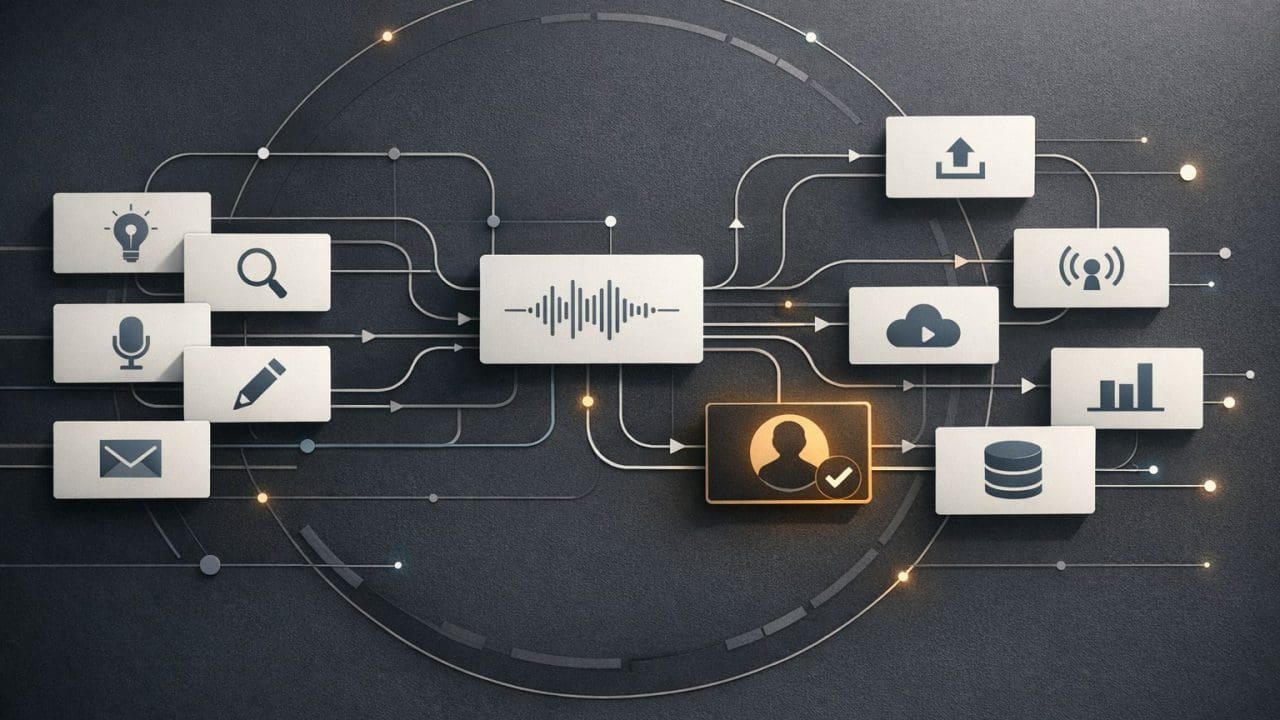
BitTalk is a live operating framework for a digital operation. Its first implementation runs a Bitcoin-focused media property that can plan topics, research stories, write podcast scripts, produce blog posts, create social media copy, generate production assets, support sponsor requirements, publish content, promote releases, monitor workflow state, and improve over time.
The podcast is one output. The framework behind it is the real story.
From AI Tool to Operating Framework.
Most AI tools still depend on a person to drive the process.
A user opens a chat, asks for help, reviews the answer, copies the output, moves to the next system, and decides what should happen next.
That can make an individual faster. It does not necessarily make the business easier to run.
BitTalk is different because the workflow itself is modeled as software. The system is designed to manage planning, research, drafting, review, audio generation, sponsor operations, publishing, promotion, retries, audit logs, and operational health.
That distinction matters. Using AI means a person asks a tool to complete a task. Operating with AI means the business process has structure, state, memory, rules, integrations, and accountability.
The First Use Case Is Media. The Framework Is Broader.
BitTalk’s first visible output is a media property.
It produces podcasts, articles, social content, promotional assets, sponsor copy, and publishing records. But the system is not limited to media.
The important part is the operating framework underneath it.
That framework can take a repeatable digital workflow and define how work moves from idea to finished output. It can assign steps to models, tools, providers, or humans. It can retrieve relevant memory, apply rules, validate outputs, route work for review, publish through integrations, and log what happened.
That is the difference between generating content and running a digital operation. A simple AI content tool creates an asset. An operating framework manages the process that creates, reviews, publishes, promotes, and improves the asset.
What the Framework Does.
A digital operation needs more than content generation. It needs a way to manage the work.
The BitTalk framework is designed around planning, research, memory, creation, production, review, publishing, promotion, guardrails, monitoring, and auditability.
Planning decides what should be created and why. Research grounds the work in relevant sources and context. Memory recalls prior coverage, decisions, voice, and patterns. Creation drafts scripts, articles, posts, briefs, and assets. Production prepares channel-specific outputs.
Review routes important or higher-risk work for human approval. Publishing sends approved outputs to the right platforms. Promotion adapts finished work into social and distribution assets. Guardrails validate outputs before they move forward. Monitoring tracks state, failures, retries, and operational health. Auditability preserves records of what happened and what was approved.
That is why BitTalk is not just an AI podcast. It is an operating framework for repeatable digital work.
Workflow Ownership Is the Real Advancement.
The breakthrough is not that AI can write a podcast script or draft a blog post.
The breakthrough is that the system can know where each item is in the process.
What has been planned? What research was gathered? What draft was created? What sponsor requirements need to be included? What has been approved? What failed? What needs to be retried? What has been published? What promotion should happen after the public URL exists?
That is workflow ownership.
A personal assistant waits for the next instruction. A digital operating framework tracks state, follows policy, routes work, handles exceptions, and moves the process forward.
That is the kind of architecture businesses need if they want AI to become more than a productivity tool.
Memory Makes the Operation More Valuable Over Time.
A business does not operate one task at a time. It builds context.
It has prior work, recurring themes, customer history, brand standards, internal rules, past decisions, and lessons learned.
A basic chatbot either forgets that context or tries to stuff too much raw history into a prompt.
BitTalk uses embedding-based memory so prior content can be summarized, embedded, and retrieved by relevance. That gives the workflow recall without flooding the model context.
The same pattern applies far beyond media. A sales system can remember prior proposals. A customer service system can remember recurring issues. A marketing system can remember what has already been published. An operations system can remember prior approvals, failures, and exceptions.
The value is not just memory. The value is relevant memory inside a workflow.
Research Grounding Keeps Automation From Becoming Guesswork.
Autonomous systems become risky when they generate output without grounding.
BitTalk is designed so research happens before drafting. The workflow gathers context, synthesizes it, and uses that research bundle to shape scripts, articles, show notes, and promotional copy.
That pattern matters for any business. A company does not want AI guessing from general knowledge when it drafts customer communications, prepares reports, summarizes policies, reviews documents, or recommends next steps.
Good automation starts with grounded information. Then the model can help structure, draft, classify, summarize, or recommend.
Different Jobs Need Different Tools.
One mistake businesses make with AI is assuming one model should do everything.
Real operations do not work that way. Different jobs require different capabilities.
Research may need one provider. Reasoning and outlining may need another. Writing may need another. Image generation, audio generation, publishing, and social copy each have different requirements.
BitTalk follows that pattern by separating model and provider responsibilities across research, reasoning, writing, image generation, audio production, publishing, and promotion.
The architecture should not be “one AI does everything.” It should be an orchestrated workflow where the right tool handles the right step.
Guardrails Turn AI Into Operations.
Prompts are not enough.
A production system needs checks around what the AI creates and what happens next.
BitTalk includes deterministic guardrails such as sponsor marker validation, sponsor-only ad blocks, show-notes reference guards, internal prompt-language repair, TTS formatting validation, voice mapping checks, provider preflight checks, WordPress publish validation, and social publishing gates after public URL confirmation.
That is the difference between a demo and an operating system.
The important question is not only, “Can AI create the output?” The more important question is, “What happens when the output is incomplete, wrong, risky, or not ready?”
A serious automation system needs to detect, repair, block, retry, or escalate. NIST’s AI Risk Management Framework is useful here because it frames trustworthy AI around governance, risk management, measurement, and accountability.
Human Review Is Part of the Operating Model.
Autonomous does not mean unsupervised.
For many business processes, human review is not a weakness. It is the control layer.
BitTalk can automate production work while still allowing humans to approve ideas, drafts, and publication depending on the workflow policy. Automation handles production labor while humans retain control over judgment, taste, risk, facts, brand, and final authority.
That is the right model for many companies. The system handles repetitive coordination. Humans supervise the decisions that matter.
Auditability Makes Automation Accountable.
A business needs to know what happened.
That means the system should keep records of runs, steps, approvals, provider usage, prompt versions, publication records, and failures.
BitTalk’s workflow is designed around approval states, step-level records, publication records, and frozen snapshots of prompt bundles and templates at approval time.
Businesses cannot rely on invisible automation. If a system sends something, publishes something, updates something, or recommends something, the company should be able to inspect the path.
How This Applies to Client Businesses.
Most businesses have digital operations that already follow repeatable patterns.
A lead comes in. A request needs triage. A proposal needs drafting. A report needs research. A campaign needs assets. A blog post needs publishing. A customer question needs context. A manager needs approval. A team needs the status.
These workflows often depend on manual coordination. The BitTalk framework points toward a different model.
Instead of asking people to move every task manually, the workflow can be modeled as software.
For clients, that could mean lead intake and qualification, proposal drafting and review, client onboarding, customer support triage, marketing campaign operations, content planning and publishing, internal reporting, executive summaries, recruiting workflows, knowledge base updates, compliance review, vendor coordination, approval workflows, and digital operations dashboards.
The workflow changes by business. The framework stays similar.
Map the process. Define the inputs. Add memory. Ground the work in the right context. Route each step to the right model, tool, provider, or person. Validate outputs. Create review points. Track state. Log outcomes. Improve the system over time.
That is how AI becomes business infrastructure, not a chatbot on the side of the company.
The Framework Can Extend as the Operation Grows.
BitTalk already produces multiple outputs: podcasts, blog posts, social media, artwork, sponsor-related copy, and publishing assets.
But the architecture is designed to extend.
New capabilities can be added as workflow steps, integrations, providers, or review policies. That matters because digital operations rarely stay fixed.
A business may start with content production, then add lead capture, reporting, CRM updates, newsletter creation, campaign planning, customer follow-up, performance summaries, or internal dashboards.
The point is not to rebuild the system every time. The point is to use an operating framework that can grow with the work.
BitTalk Is Live, Not Theoretical.
BitTalk is not an experiment sitting in a lab.
It is a live operating framework running a real digital operation. It publishes, promotes, monitors, remembers, and improves across multiple channels.
That makes it useful beyond the content it creates.
It shows what happens when digital work is modeled as software: planning, research, creation, production, review, publishing, promotion, monitoring, and memory, all moving through an auditable system where humans supervise the decisions that matter.
For Eckman Design, that is the larger lesson. AI automation is not just about making individual tasks faster. It is about building operating frameworks that make digital work easier to run, easier to govern, and easier to extend.
Eckman Design helps businesses turn repeatable digital workflows into practical AI-assisted operating frameworks. BitTalk is one live example of how strategy, automation, software, publishing, promotion, and human review can work together as an extensible digital operation.
Discussion
0 Comments