
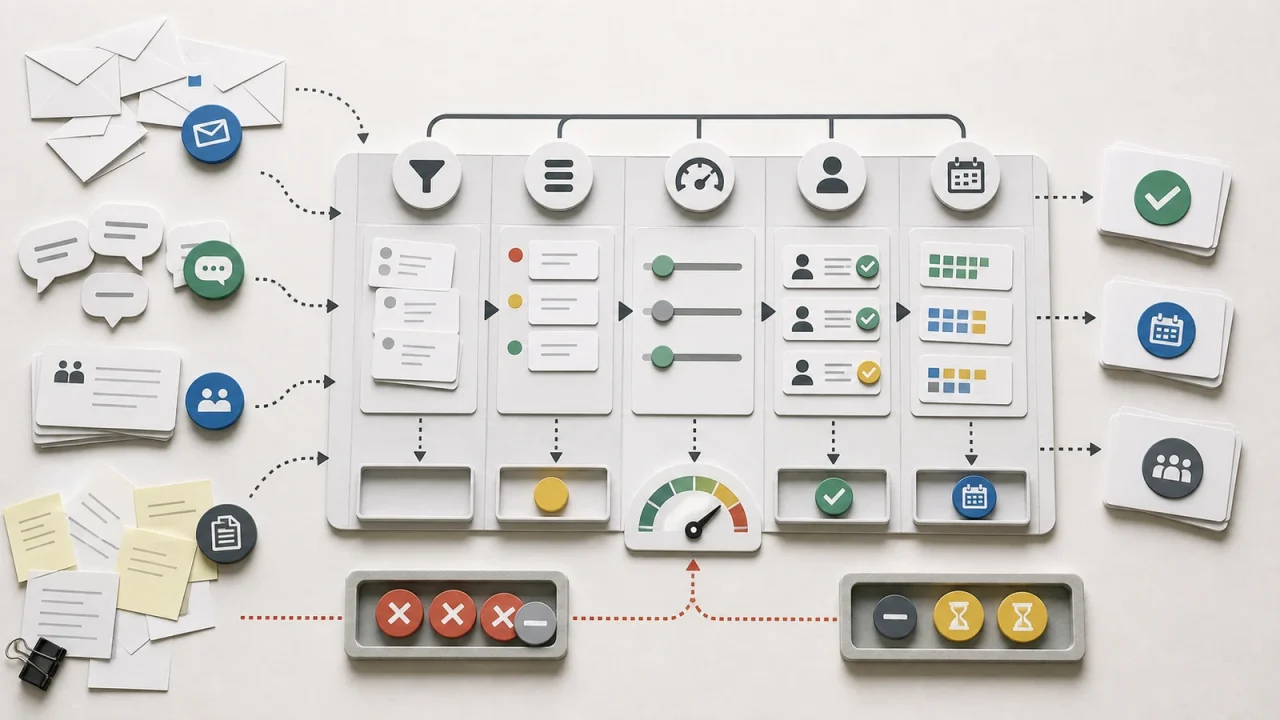
A project intake process breaks when every request enters the business through a different side door.
Scattered requests hide demand because work arrives through email, chat, meetings, hallway conversations, and old documents.
A project intake process creates one front door for triage, priority, ownership, capacity, and scheduling.
The goal is not to slow people down. The goal is to make decisions visible before the team commits.
Start by defining what counts as a request, who can approve it, and how work moves from idea to scheduled commitment.
Scattered Requests Hide The Real Workload
Most teams do not have a project capacity problem that appears all at once. They have a visibility problem that grows quietly. Requests arrive through email, chat, meetings, direct messages, spreadsheets, support tickets, voice notes, and comments inside old documents.
Each request may seem reasonable in isolation. A quick website update. A reporting change. A new automation idea. A client deliverable. A small internal tool improvement. A rush request from leadership. A follow-up from last week’s meeting.
The problem is that nobody can see the whole demand picture. The team only sees fragments. As a result, people say yes too early, duplicate work, miss dependencies, accept unclear scope, and discover capacity problems after commitments have already been made.
A project intake process gives the business one place to understand demand before work becomes a promise. It does not need to be complicated. It needs to make request quality, priority, ownership, and capacity visible enough for a decision.
The Front Door Should Define A Real Request
A good intake process starts by defining what counts as a project request. Without that definition, every idea becomes work in disguise.
Some requests are tasks. Some are questions. Some are bugs. Some are strategic opportunities. Some are operational symptoms that need investigation before anyone chooses a solution. Treating all of them as projects makes the pipeline noisy and makes prioritization harder than it needs to be.
The intake form or request channel should collect enough information to classify the work. What problem needs attention? Who is affected? What outcome would make the request successful? What is the deadline and why does it matter? Which systems, teams, or customers are involved? What happens if the team does nothing for two weeks?
These questions force useful clarity. They help the team separate urgent work from loud work, valuable work from vague work, and ready work from ideas that need discovery. The goal is not to make people fill out paperwork. The goal is to keep the team from committing to work it does not yet understand.
This is similar to a customer intake workflow. Capture matters, but the operating model after capture matters more.
Triage Protects Focus
Triage is where the intake process earns trust. It turns an incoming request into a decision: reject, clarify, route, schedule, defer, or escalate.
Without triage, the team either starts too much work or lets requests disappear. Both outcomes create frustration. Stakeholders feel ignored. Operators feel overloaded. Leaders lack a clear view of what the team is actually carrying.
A useful triage step should answer a few questions quickly. Does this request fit the team’s responsibility? Is the outcome clear? Is there enough information to estimate effort? Does the request have a real deadline? Does it depend on another team? Does it conflict with current commitments?
The answer may be “not yet.” That is a valid intake outcome. A request that needs more context should move to clarification instead of entering active work with assumptions attached. This keeps uncertainty visible instead of pushing it into execution.
Triage also creates a record of decisions. That record matters when priorities change, when stakeholders ask why something has not started, and when the team reviews whether the intake process is producing better decisions.
Capacity Has To Be Part Of The Decision
Project intake fails when priority is discussed without capacity. A request can be important and still not fit the team’s current workload.
The Kanban Guide is useful here because it emphasizes visualizing work, actively managing items, and limiting work in progress. Those ideas apply directly to intake. A team cannot make good project decisions if new work is approved without seeing what is already underway.
Capacity should not be a vague feeling. The team needs a simple way to see active work, queued work, blocked work, and available decision points. That might be a board, dashboard, intake queue, or weekly review. The format matters less than the shared visibility.
When capacity is visible, the business can make tradeoffs. Start the new request and pause something else. Defer it until the next planning window. Split it into a smaller first step. Move it to a different owner. Reject it because the value does not justify the disruption.
Those tradeoffs happen whether or not the team admits them. A project intake process makes them explicit before the damage shows up as missed deadlines, context switching, and quiet resentment.
Status Visibility Reduces Follow-Up Noise
One reason requests scatter is that people do not trust the existing system. If stakeholders cannot see whether a request was received, reviewed, approved, or scheduled, they create their own follow-up channels.
A clear intake process should show the request state without requiring another meeting. Received. Needs clarification. Under review. Approved for scheduling. Deferred. In progress. Blocked. Complete. The states should match the way the team actually works.
This does not mean every stakeholder needs access to every operational detail. It means the people who submit requests should know where the request stands and what will happen next. Silence creates duplicate messages. Duplicate messages create more work.
A dashboard can help, but only if it supports decisions. As with a dashboard that replaces status meetings, the intake view should answer operational questions. What needs review? What is blocked? What is waiting on a stakeholder? What has been approved but not scheduled?
The Tool Should Follow The Operating Model
Teams often jump from scattered requests to a tool debate. Should intake live in a project management platform, CRM, ticketing system, form builder, spreadsheet, or custom internal tool?
The better order is to define the operating model first. Decide what information is required, who reviews requests, what states the request can move through, how priorities are set, how capacity is checked, and how stakeholders receive updates.
Once those rules exist, the tool choice becomes clearer. Some teams need a lightweight form and board. Others need integrations with CRM, support, finance, or engineering systems. Some need custom software because the workflow crosses too many disconnected tools. The right system depends on how the work actually moves.
This is why low-code automation still needs workflow ownership. A tool can make the workflow easier to run, but it cannot decide the rules, tradeoffs, and responsibilities for the business.
A Practical Starting Point
Start by collecting the last twenty project requests, even if they arrived through different channels. For each one, write down the source, requester, problem, desired outcome, owner, current status, missing information, and whether the team actually had capacity when it was accepted.
Patterns will appear quickly. Some requests arrive incomplete. Some bypass the normal owner. Some should be handled as tasks, not projects. Some need approval before anyone spends time estimating them. Some repeat because the underlying system needs improvement.
Use those patterns to design the first version of intake. Keep it simple enough that people will use it and structured enough that the team can make better decisions. Define the required fields, triage owner, decision states, review rhythm, and capacity check.
The best project intake process does not make work disappear. It makes demand visible before the team says yes. That visibility gives the business a chance to choose the right work, sequence it realistically, and stop treating scattered requests as a normal way to operate.
Discussion
0 Comments